

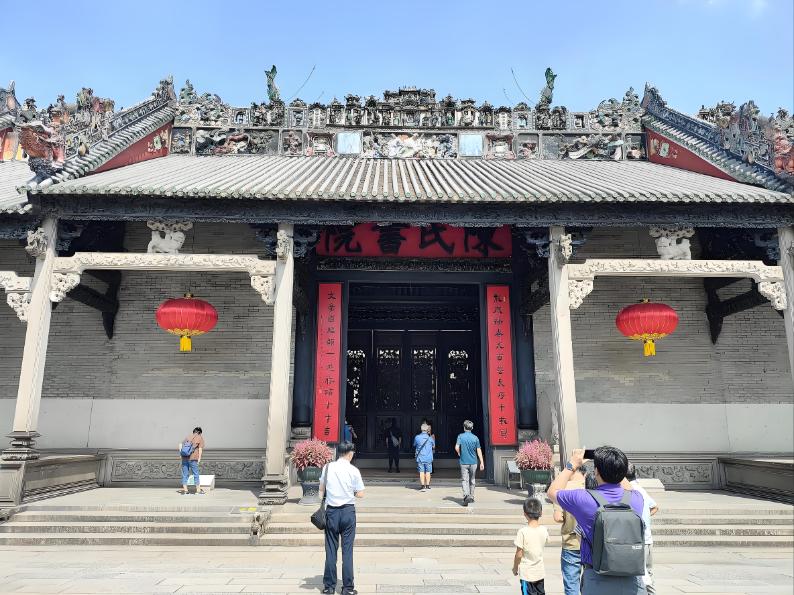
A Living Gallery of Southern Chinese Architecture
Tucked in the heart of Guangzhou, the Chen Clan Ancestral Hall (also known as the Chen Clan Academy) is one of the most well-preserved and artistically rich traditional complexes in southern China. Originally built in 1894 by the Chen family as a study hall and ancestral shrine, the site now serves as a museum of folk art, offering a deep dive into the architectural aesthetics, craftsmanship, and spiritual traditions of the Lingnan region.
The moment you step into the complex, you are surrounded by intricate craftsmanship. The hall’s courtyards, corridors, and pavilions are adorned with carved wood panels, stone columns, ceramic figures, and painted murals. It’s a place where every corner tells a story — not just of the Chen family, but of the cultural legacy they helped preserve.
The Art of Detail
One of the most breathtaking features of the Chen Clan Hall is its use of Lingnan decorative art. Wood carvings fill entire walls and doors with mythological scenes and auspicious motifs — phoenixes, dragons, peonies, and scholars in flowing robes. Stone carvings, meanwhile, appear on balustrades and stairways, offering durability and balance to the more delicate wooden elements.
Perhaps the most captivating are the gray clay sculptures along the rooftops, an art form known as huī sù. These rooftop figures seem to leap into life — warriors in mid-battle, fishermen casting nets, or scenes from opera plays caught in expressive movement. Every sculpture is not just ornamental but narratively rich.
Ceramic mosaic work adds yet another layer. Glazed tiles in vivid reds, blues, and greens trace elegant curves along beams and arches, depicting birds, flowers, and scenes from Cantonese folklore. The overall visual impact is both dense and harmonious, reflecting an aesthetic where storytelling and ornamentation go hand in hand.
Cultural Depth and Symbolism
The Ancestral Hall isn’t merely a display of artistic technique—it’s also deeply embedded in the values of family, education, and Confucian respect for ancestry. The very layout of the building, with its symmetrical axis and layered courtyards, mirrors the Confucian concept of order and hierarchy.
The main ancestral shrine, with incense still wafting through the air, remains a space of reflection and reverence. Even without knowing the full context, visitors often describe a strong emotional impact when entering this space — a sense of stepping back in time and touching the spiritual heart of a once-influential family.
Interactive English-Guided Experience
The Chen Clan Ancestral Hall is highly accessible to international visitors thanks to its English-language guided tours. The staff are knowledgeable and passionate, often explaining not only the history of the site but also the stories behind individual carvings and motifs. QR codes around the complex offer audio explanations in multiple languages, making it easy to explore at your own pace.
There are also hands-on exhibits that introduce traditional Lingnan crafts, from brush painting to embroidery and paper-cutting. Temporary exhibitions within the side galleries showcase Cantonese opera costumes, antique furniture, and lacquerware, offering a wider view of regional art traditions.
Visitor Impressions
Anna from the Netherlands, a design student, described the Chen Clan Hall as “a masterclass in pattern and proportion.” She was particularly impressed by the way the rooftop sculptures seemed to blend architecture and performance art.
Michael, an architect from Canada, called it “one of the finest examples of preserved decorative construction I’ve seen anywhere in Asia.” He was especially drawn to the way wood, stone, and ceramic were used in harmony to create both structural and artistic balance.
Ling from Singapore visited with her elderly parents and appreciated the quiet, meditative quality of the space. “You can feel the rhythm of family generations here,” she said. “It’s not just a museum — it’s a memory palace.”
Tips for Visiting
Located close to the Chen Clan Academy metro station, the ancestral hall is easily accessible from anywhere in Guangzhou. It’s best visited in the morning or late afternoon when the light slants across the courtyards, casting dramatic shadows on the carvings.
Wear comfortable shoes, as the site is large and encourages slow walking and discovery. Photography is allowed, but flash should be avoided to preserve delicate surfaces. The souvenir shop offers beautifully made replicas of Lingnan folk art, including hand-carved bookmarks and ceramic miniatures.
For those interested in traditional Chinese architecture or looking for an experience that balances serenity with cultural richness, the Chen Clan Ancestral Hall provides both. It’s a quiet, visually stunning counterpoint to the city’s modern energy — a space where heritage is not only preserved but felt.