
Tucked away in the bustling cityscape of modern Shanghai, Yuyuan Garden (also spelled “Yu Garden”) offers a tranquil escape into a world of classical Chinese elegance. For travelers from the West seeking authenticity, history, and aesthetic beauty, this 16th-century garden is more than just a popular attraction — it’s a living tapestry of China’s cultural soul.
🌿 A Glimpse into Ancient China
Yuyuan Garden was built during the Ming Dynasty in 1559 by Pan Yunduan, a government official who wanted to create a peaceful retreat for his aging parents. The name “Yu” (豫) means “peace” and “comfort,” reflecting the original intention behind its design — a place of serenity amid chaos.
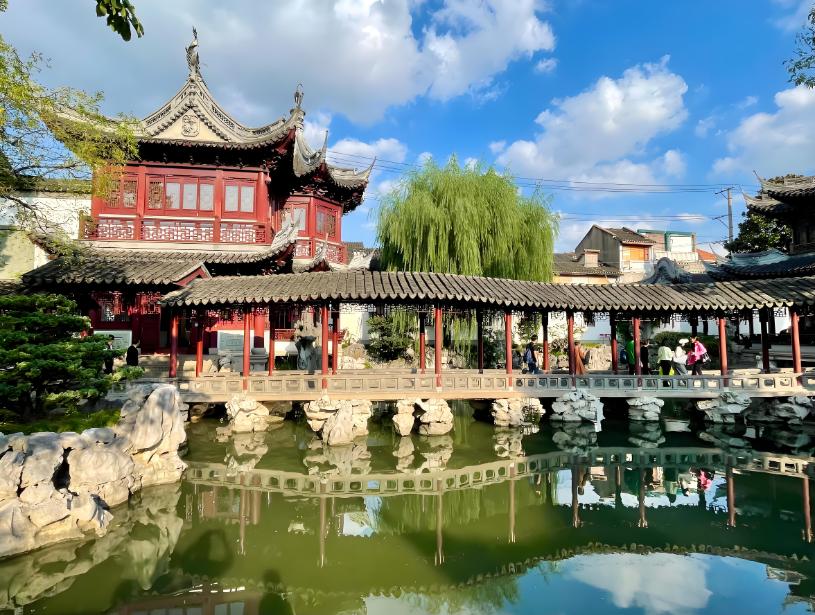
Unlike the rigid formality of European palaces or the wild grandeur of nature parks, Chinese classical gardens are poetic microcosms, and Yuyuan is among the finest examples. Spread across five acres, it uses meticulous landscaping, water features, pavilions, bridges, and rockeries to create a sense of infinite space and storytelling. Every turn of the path, every curve of a roof, and every reflection in the koi ponds is deliberate — designed to evoke harmony between man and nature.
🏯 Architectural & Aesthetic Wonders
Western travelers are often captivated by Yuyuan’s intricate details. The garden is a master class in classical Jiangnan (south of the Yangtze) garden style. Highlights include:
Exquisite Rockeries: The Great Rockery (Dianchun Hall Rockery) at the entrance, built from huangshi stone, offers a sweeping view of the garden and was once used by rebels during the Taiping Rebellion.
Dragon Walls: These undulating walls are adorned with dragon sculptures whose bodies ripple across the garden boundaries — symbolizing imperial power and protection.
Pavilions and Halls: Names like the Hall of Heralding Spring or the Hall of Jade Magnificence add a poetic rhythm to the experience. Inside, the wooden carvings and traditional furniture tell stories of a bygone era.
Bridges and Waterways: The most famous is the Nine Zigzag Bridge, which leads to the Huxinting Teahouse — a picturesque pavilion floating in the middle of a pond. Legend says evil spirits can only move in straight lines, so zigzag bridges were protective as well as decorative.
🎎 Cultural Immersion & Local Life
Yuyuan is not just a museum-like site frozen in time. It is nestled in Yuyuan Old Street, a vibrant maze of narrow alleyways lined with traditional-style buildings. Here, you can see and taste local life:
Try xiaolongbao (soup dumplings) from the legendary Nanxiang Steamed Bun Restaurant — a favorite among both locals and tourists.
Browse stalls selling silk fans, calligraphy brushes, tea leaves, and jade trinkets.
Witness folk crafts and shadow puppet demonstrations — echoing centuries of Chinese artistry.
For many Western travelers, this blend of “living heritage” makes Yuyuan more than a postcard—it’s an experience.
🧭 Why Travelers Love It
1. A Contrast to Modern China
Visitors often say that stepping into Yuyuan feels like stepping back in time. After days spent among Shanghai’s towering skyscrapers and high-speed trains, Yuyuan’s winding paths and tiled roofs provide an intimate counterpoint — a place to slow down, reflect, and connect with China’s roots.
“I never expected to find this much calm and beauty in the middle of such a huge metropolis. Yuyuan feels like a dreamscape.” — Amanda R., traveler from Canada
2. Photographer’s Paradise
With its ornate gates, intricate lattice windows, koi ponds, bonsai trees, and lantern-lit halls, the garden is beloved by photographers and Instagrammers. The contrast of old against new — especially with the Lujiazui skyline visible in the background — is uniquely Shanghai.
3. Rich Storytelling & History
Guided tours (available in English) bring the space to life, from tales of rebellion and imperial rituals to Feng Shui symbolism. For many visitors, this deeper understanding of Chinese philosophy and aesthetics makes the visit intellectually rewarding.
4. Accessible Yet Authentic
Unlike remote historical sites, Yuyuan is easily reachable — located in Huangpu District, near the Bund and Nanjing Road. It’s a perfect half-day excursion that blends sightseeing, shopping, dining, and culture.
💡 Visitor Tips
Go early to avoid crowds, especially on weekends and public holidays.
Join a guided tour or use an audio guide app to fully appreciate the symbolism and history.
Don’t miss the nearby Chenghuang Miao (City God Temple), a Taoist temple that further deepens the cultural experience.
Best time to visit: Spring (March–May) or Autumn (October–November) when the weather is mild and the garden is most colorful.
📍 Essential Info
Address: 218 Anren Street, Huangpu District, Shanghai
Metro: Line 10, Yuyuan Garden Station (Exit 1)
Hours: 8:30 AM – 5:30 PM
Admission: ~40 RMB (about $6 USD)
Yuyuan Garden is more than just a scenic spot — it’s a doorway into the artistic, philosophical, and emotional landscape of China’s past. For Western travelers, especially those fascinated by culture, design, and history, it’s a must-see that reveals the quiet elegance at the heart of a fast-moving city.
When you leave, you won’t just remember the architecture or the dumplings — you’ll remember how the space made you feel: calm, curious, and connected to a culture thousands of years old.